
Chickasaw County Court Records After Arrest
After a Chickasaw County arrest, the first public record may be a jail or law-enforcement record. The person may be taken to the Chickasaw County Jail if they are not cited and released. Booking captures local custody facts such as the name used at intake, the arresting agency, booking allegations, release status, and bond information if staff may release it. The court side starts later. A prosecutor reviews the arrest report and decides what charge to file in Iowa district court, whether to amend the allegation, or whether no charge should be filed. Once that filing occurs, the formal case can be searched as a Chickasaw County court record after arrest.
The local court channel is Chickasaw County District Court, listed by the Iowa Judicial Branch at 8 E Prospect St, New Hampton, IA 50659, with clerk phone 641-394-2106. The jail and court records should not be merged. Current custody and booking-bond questions belong with the sheriff or jail, while filed charges, hearings, formal bond orders, and dispositions are court matters. For the custody side, use Chickasaw County jail inmate records; for booking-photo issues, use Chickasaw County jail mugshots.
Find Chickasaw Court Records
Iowa Courts Online is the public portal for many Iowa trial-court records, including criminal cases filed after a Chickasaw County arrest. It is not an inmate roster and does not prove that a person is still in custody at the Chickasaw County Jail. It is useful after the prosecutor has filed a case because it can show the case number, charge list, court location, hearing dates, bond order entries, attorneys, disposition, financials, and docket events when public. If no case appears, the charge may not be filed yet, the spelling may differ, the case may be in another county, or the record may be restricted.
| Field Label | Type | Required | Notes |
|---|---|---|---|
| Trial Court / Case Search | Mode or link | Yes | Use for Iowa district court criminal cases. |
| Name Search | Text | Optional | Search by defendant last and first name; spelling and middle initials matter. |
| Case ID / Case Number | Text | Optional | Best when taken from a citation, bond paper, court notice, or clerk response. |
| Citation Number | Text | Optional | Useful when the arrest began with a citation or traffic/simple misdemeanor matter. |
| County | Filter | Optional | Narrow to Chickasaw County when the portal exposes county filtering. |
| Search / Submit | Button | n/a | Runs the query. |
The Iowa Courts Online search interface is the right visual match for this court-record topic.
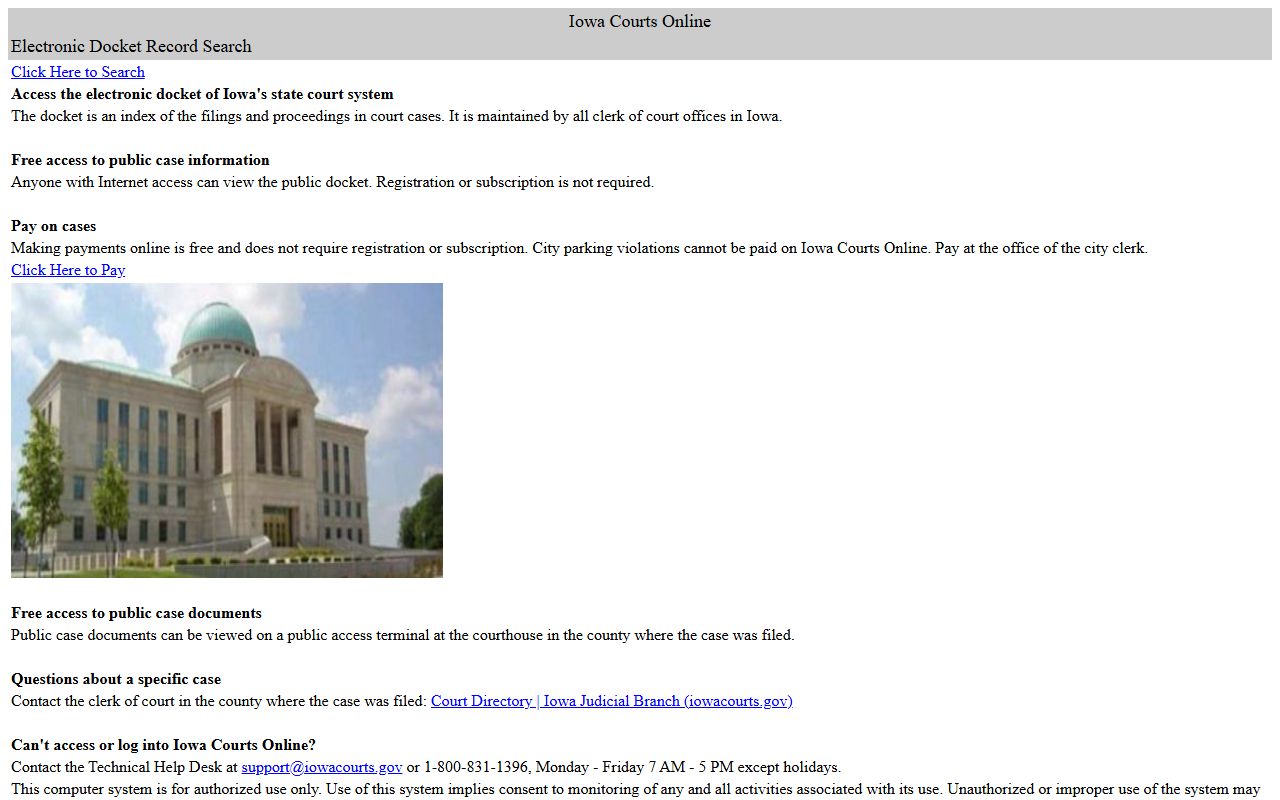
Use the court portal for filed case records, then call the Chickasaw County clerk if the online result does not answer a case-specific public-record question.
Chickasaw Arrest Charges Filed
The prosecutor for local criminal cases is the Chickasaw County Attorney's Office, not a district attorney. The county attorney reviews law-enforcement reports after arrest and decides which charges to file, amend, reduce, or dismiss. Iowa court filings can use different charging documents depending on the charge and stage. The booking charge heard at the jail may be a starting label. The court charge is the allegation that moves through the case.
| Document | Who Files It | Common Use | Why It Matters |
|---|---|---|---|
| Complaint | Officer or prosecutor | Often starts a criminal case or states the accusation. | Shows the first formal court allegation after arrest. |
| Citation | Law enforcement | Traffic and simple misdemeanor matters may begin this way. | Can create a court case even when the person was not held long in jail. |
| Trial information | Prosecutor | Used in Iowa indictable cases after preliminary steps. | May replace or refine earlier booking or complaint language. |
| Indictment | Grand jury | Less common than prosecutor-filed charges. | States grand-jury charges that move in court. |
Iowa Code chapter 804 covers arrest procedure, while the court docket shows what happens once a charge is filed. That distinction is key in a Chickasaw County court records after arrest search. One arrest can produce no case, one case, or more than one case. One case can also contain several counts. A charge can be amended after first filing, so early court records should be read as a case snapshot, not as the final result.
Chickasaw Charge Status Terms
Charge status tells where a filed count stands. A pending charge is still moving. An amended charge changed from the earlier version. A dismissed charge ended without conviction on that count. A deferred judgment can alter later public access if statutory conditions are met. The docket may also show warrants, bond forfeiture, pleas, orders, and sentencing entries. These terms matter because Chickasaw County court records after arrest can change long after booking day.
| Status | Plain Meaning | Record Caution |
|---|---|---|
| Pending | The case or charge is still open. | Do not treat it as a conviction. |
| Amended | The charge was changed by court or prosecutor action. | Compare the current charge to the first filing and booking charge. |
| Dismissed | The count or case ended without conviction on that matter. | Dismissal does not always remove public history by itself. |
| Deferred judgment | The court delays judgment under statutory conditions. | Later confidentiality or expungement questions are case specific. |
| Warrant issued | The court issued arrest process, often after missed court. | Use official court, sheriff, or attorney channels for next steps. |
| Disposition | The court result for a charge or case. | Read each count because outcomes can differ within one case. |
Bond After Chickasaw Arrest
Bond and release information can exist in both the jail process and the court record. The official Chickasaw County Jail page says bail for inmates in the jail is handled by contacting the jailer on duty at 641-394-3121. It does not publish an online bond-payment portal, accepted payment methods, bond window hours, a credit-card vendor, or a bondsman list. After filing, Iowa Courts Online or the clerk may show formal court bond orders, conditions, hearings, and changes.
| Bond Type | How It Works | Chickasaw County Note |
|---|---|---|
| Cash bond | Money posted directly as required by court or jail. | Call the jailer for accepted method and location. |
| Surety bond | Bond backed by an authorized surety if permitted. | No official local agent list was captured. |
| Personal recognizance | Release on written promise and court conditions. | Look for court order terms after the case is filed. |
| No-bond hold | Payment will not release the person at that point. | Ask whether another warrant, order, or detainer applies. |
| Agency hold | Another agency wants custody or transfer. | May involve another county, DOC, USMS, or ICE. |
Iowa Code chapter 811 governs release and bail, and the Iowa Judicial Branch publishes a uniform bond schedule for background. A scheduled amount is not always the final order. A judge can add no-contact terms, travel limits, supervision, substance restrictions, a higher or lower bond, or detention conditions. Posting local bond also does not clear a separate hold.
Warrants and Court Records
No official Chickasaw County active-warrant database was located on the sheriff or county website. Iowa Courts Online may show bench warrants, failure-to-appear entries, bond forfeiture, or warrant-related docket events after a case exists. The sheriff can answer warrant-process questions through 641-394-3121, and the clerk can answer public case-record questions through 641-394-2106. A person who may have a warrant should not rely on a commercial warrant site or guess based on an old docket entry.
A warrant arrest can become a Chickasaw County jail booking. The booking line may say warrant or failure to appear, while the court record shows the older case that caused the warrant. If the warrant belongs to another county, Chickasaw County may hold the person for transfer or further court action. If bond appears available, ask jail staff whether any other warrant, probation/parole hold, federal hold, or immigration detainer prevents release.
Charges and Convictions Compared
An arrest, a booking charge, and a court charge are not convictions. A charge is an accusation or formal allegation. A conviction requires a plea, verdict, judgment, or other court result that establishes guilt for that count. This is why Chickasaw County court records after arrest must be read count by count and date by date. The same court case can show one dismissed count, one amended count, and one conviction.
| Point | Charge | Conviction |
|---|---|---|
| Stage | Accusation filed in court. | Final or qualifying court result on a count. |
| Proof | Based on allegations and legal process. | Based on plea, verdict, judgment, or accepted disposition. |
| Can change? | Yes, it can be amended, reduced, or dismissed. | May be appealed, corrected, deferred, or later affected by statute. |
| How to read it | Check current status and next hearing. | Check disposition, sentence, and any later expungement order. |
Sealed and Expunged Records
Public access has limits. Juvenile matters, sealed records, expunged records, protected personal data, victim information, and some document images may be withheld even when a docket exists. Iowa Code chapter 901C addresses expungement of certain eligible criminal records, while chapter 232 covers juvenile confidentiality. A dismissal or deferred judgment does not mean every public trace disappears by itself.
| Point | Sealed or Confidential | Expunged |
|---|---|---|
| Public view | Hidden or restricted from general public access. | Treated as confidential where the statute and order apply. |
| Source | Court rule, statute, juvenile law, or specific order. | Iowa expungement statute and a qualifying court order. |
| Law-enforcement access | May still exist for limited lawful uses. | May still exist for limited statutory uses. |
| Practical step | Ask the clerk what public access is allowed. | Use court process or legal counsel for eligibility and filing. |
Important: Clerk staff can provide public case information, but they cannot give legal advice about expungement, warrants, pleas, or defense strategy.
Restricted Chickasaw Court Records
Iowa Code chapter 22 starts with public access to records unless a law makes a record confidential, but law-enforcement and court records can include exceptions. A booking sheet, charging document, or case docket may be partly public while a police report, juvenile file, victim information, medical data, social security number, or sealed document is not. The correct request is narrow: name the person, date range, case number if known, and exact record sought.
For Chickasaw County court records after arrest, use Iowa Courts Online first, then contact the clerk at 8 E Prospect St if the record is older, restricted, missing online, or unclear. For prosecutor identity and charging role, use the Chickasaw County Attorney website. For current custody, bond posting instructions, and booking status, call the Chickasaw County Jail at 641-394-3121. Each office controls a different part of the arrest-to-court path.